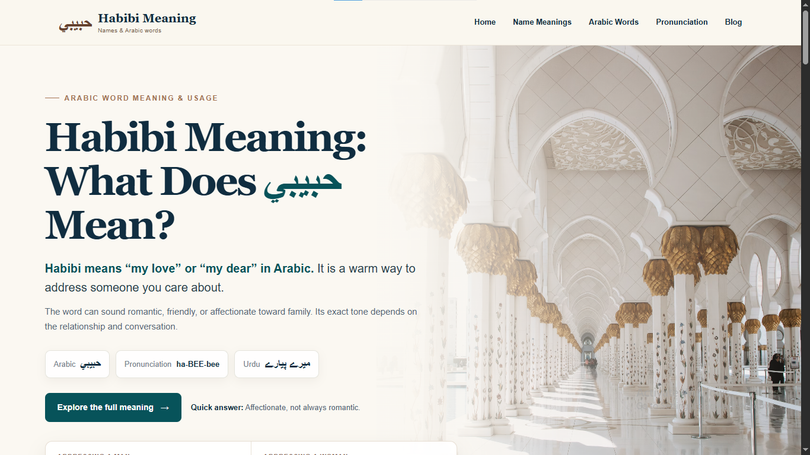

Arabic has many beautiful words that express love, friendship, respect, and affection. One of the most familiar Arabic expressions around the world is habibi. It appears in everyday conversations, music, movies, social media captions, and personal messages.
But what does this popular word actually mean?
The habibi meaning is generally understood as “my dear,” “my beloved,” “my darling,” or “my love.” Its use is not limited to romantic relationships. Depending on the situation, it can also be a warm way to address a friend, family member, or someone close.
What Does Habibi Mean?
Habibi (حبيبي) is an Arabic term used to express affection and familiarity. The word comes from the Arabic root associated with love and being beloved.
In English, it can have several natural translations, including:
- My dear
- My beloved
- My darling
- My love
- Dear friend
The best translation depends on the person using the word and the situation in which it appears.
Habibi Meaning in Arabic
The Arabic spelling of habibi is حبيبي. It is related to the word habib, which means beloved or dear.
The ending gives the word a possessive sense, so habibi can be understood literally as “my beloved” or “my dear.”
Arabic also uses different forms depending on the gender of the person being addressed. This is why you may hear both habibi and habibti in Arabic conversations.
What Is the Difference Between Habibi and Habibti?
The two words have the same basic idea but are generally used for different genders.
Habibi (حبيبي) is commonly used when addressing a male.
Habibti (حبيبتي) is commonly used when addressing a female.
For example, someone speaking affectionately to a male friend may say “habibi,” while the corresponding form for a female friend is generally “habibti.”
Both words communicate warmth and affection.
Is Habibi a Romantic Word?
Many people assume that habibi is always romantic, but that is not the case.
Romantic partners may certainly use it with each other. In that setting, the word can be similar to “my love” or “darling.”
However, Arabic speakers can also use habibi with friends and family. A close friend might use it as a friendly term of affection, while parents or relatives may use it when speaking warmly to someone in the family.
Therefore, the word itself does not automatically indicate a romantic relationship.
How Is Habibi Used in Everyday Conversation?
Habibi can appear in many types of conversations.
With Friends
Close friends may use habibi to create a friendly and familiar tone. It can be especially common in informal conversations.
With Family
Family members may use affectionate expressions such as habibi when speaking to children, siblings, or other relatives.
Between Couples
For romantic partners, habibi can express love and emotional closeness. In English, “my love” is often a suitable translation.
In Casual Messages
The expression is also popular in texts and online chats. Someone might use it when saying hello, thanking another person, or simply addressing someone they know well.
Habibi Meaning in English
Translating habibi directly into English can be slightly difficult because the emotional tone changes with the situation.
For example, “my love” may work well when the word is used between romantic partners. In a friendly conversation, “my dear” may sound more natural.
Other possible translations include:
- Beloved
- Darling
- Dear
- My dear one
- Sweetheart
There is therefore no single English translation that fits every use of the word.
What Does Habibi Mean in Texting?
Habibi is frequently seen in text messages, comments, and social media conversations.
Consider these examples:
“Good morning, habibi.”
This can be an affectionate greeting.
“Thank you, habibi.”
This may express appreciation toward a close person.
“How are you, habibi?”
A friend may use this as a warm and familiar greeting.
These examples demonstrate how the same Arabic word can work in different types of relationships.
Why Is the Word Habibi So Popular?
Habibi has gained international recognition through Arabic music, entertainment, social media, and online communication.
People who do not speak Arabic may encounter the word in songs, movies, videos, captions, or conversations with Arabic speakers. Its simple pronunciation and positive emotional meaning have also helped make it widely recognizable.
Today, habibi is understood in many parts of the world even outside Arabic-speaking communities.
Cultural Importance of Habibi
Language often reflects the way people build relationships, and habibi is a good example. The word can communicate familiarity and affection without requiring a lengthy explanation.
Its frequency and meaning can vary depending on the speaker, region, relationship, and situation. In some conversations it may sound very affectionate, while in others it can be a casual expression between people who know each other well.
This flexibility makes habibi an interesting part of everyday Arabic communication.
Common Questions About Habibi
What does habibi mean?
Habibi generally means “my dear,” “my beloved,” “my darling,” or “my love.”
Is habibi Arabic?
Yes. Habibi is an Arabic word written as حبيبي.
Can habibi be used between friends?
Yes. Close friends may use habibi as a friendly and affectionate form of address.
Is habibi always romantic?
No. It can be romantic, but it is also used among friends and family members.
What does habibti mean?
Habibti is the commonly used feminine form of the expression and generally means “my dear” or “my beloved.”
Can women say habibi?
Yes. The speaker’s gender does not determine the word in the same way as the gender of the person being addressed. Habibi is generally directed toward a male, while habibti is generally directed toward a female.
Final Thoughts
The habibi meaning is closely associated with affection, warmth, and closeness. Although it is often translated as “my love,” the word can also mean “my dear,” “my beloved,” or “my darling.”
Its use extends beyond romance, making it suitable for conversations between friends and family members as well. Learning the difference between habibi and habibti also provides a useful introduction to Arabic terms of affection.
Whether you see habibi in a message, hear it in a song, or encounter it in everyday conversation, its central idea remains one of warmth and affection.