
Romantic poetry in English literature is known for its deep emotions, beautiful imagination, love of nature, and freedom of thought. It allows readers to feel emotions rather than simply understand words. Love, beauty, dreams, loneliness, nature, memory, and human feelings often become the heart of Romantic poetry.
When we hear the word “romantic,” we may immediately think about love between two people. However, Romantic poetry in English literature has a much wider meaning. Romantic poets wrote about nature, personal freedom, imagination, childhood, beauty, hope, sadness, and the mysteries of life.
In this guide, we will explore Romantic poetry in simple English, understand its major features, discover important Romantic poets, and enjoy some original romantic poetry inspired by its emotional style.
What Is Romantic Poetry in English Literature?
Romantic poetry is a form of poetry that became especially important in English literature during the late 18th and early 19th centuries. The Romantic movement focused strongly on emotions, imagination, nature, individual experience, and freedom.
Romantic poets did not want poetry to feel cold or overly formal. They wanted readers to experience feelings through words.
In simple terms, Romantic poetry says:
Feel the world with your heart, notice the beauty around you, and let imagination give ordinary things a deeper meaning.
A flower may be more than a flower. A lonely road may represent a journey through life. The moon may remind someone of love, hope, or loneliness. This emotional connection between people and the world is one of the beauties of Romantic poetry.
Why Is Romantic Poetry Important in English Literature?
Romantic poetry changed the way many writers thought about poetry.
Instead of concentrating mainly on rules and formal language, Romantic poets gave greater importance to individual feelings and imagination. They found inspiration in mountains, rivers, birds, flowers, memories, dreams, and ordinary human experiences.
This made poetry feel personal and alive.
Readers could recognize their own emotions in a poem. Someone feeling lonely could connect with a lonely speaker. Someone in love could understand a poem about beauty and affection. Someone surrounded by nature could discover a deeper meaning in a simple natural scene.
That emotional connection is one reason Romantic poetry remains widely studied today.
Main Features of Romantic Poetry
1. Love of Nature
Nature is one of the strongest themes in Romantic poetry.
Romantic poets often described mountains, rivers, forests, flowers, clouds, birds, stars, and changing seasons. Nature was not simply decoration in their poems. It could become a teacher, friend, source of peace, or reflection of human emotions.
A peaceful landscape might represent happiness, while a storm could reflect fear or emotional struggle.
2. Deep Human Emotions
Romantic poetry gives great importance to feelings.
Love, happiness, sadness, loneliness, hope, fear, desire, and memories can all become subjects of poetry.
Instead of hiding emotions, Romantic poets often explored them openly.
3. Power of Imagination
Imagination is another major element of romantic poetry in English literature.
Romantic writers believed imagination could help people see beyond ordinary reality. Through imagination, a simple object or moment could become something meaningful and beautiful.
The night sky could inspire thoughts about eternity. A bird could represent freedom. A beautiful place could bring back memories from childhood.
4. Individual Freedom
Romantic poets valued individual thought and personal freedom.
They often focused on a person’s private experiences rather than only writing about society as a whole.
This is why many Romantic poems feel personal even when they discuss universal subjects.
5. Beauty and Love
Beauty appears in many forms in Romantic poetry.
It can be the beauty of a person, nature, memory, imagination, or a brief moment.
Love can also appear as affection, longing, admiration, separation, or emotional attachment.
6. Simple and Natural Expression
Some major Romantic writers supported poetry that connected with ordinary life and natural human feelings.
This helped move poetry away from unnecessarily complicated expression and closer to experiences that readers could recognize.
Famous Romantic Poets in English Literature
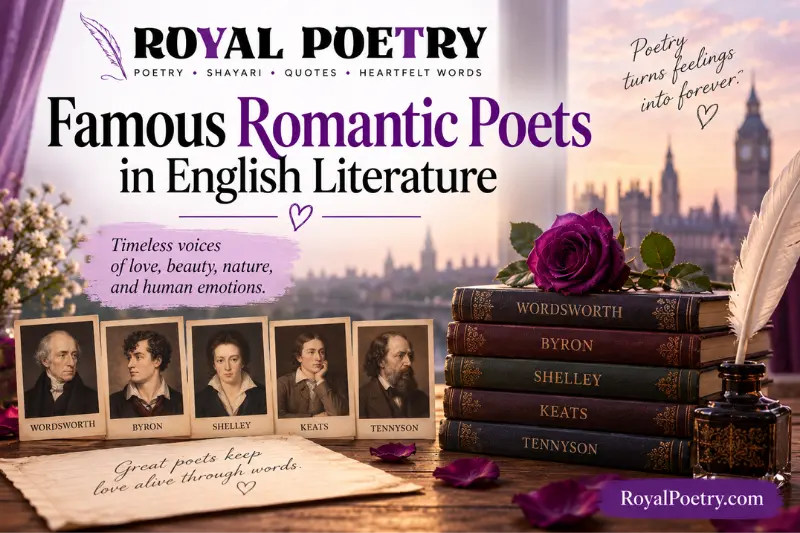
Several writers played an important role in the Romantic movement.
William Wordsworth
William Wordsworth is one of the most important names associated with English Romantic poetry.
Nature plays a central role in much of his work. He explored how natural surroundings, memories, childhood experiences, and ordinary life could influence human emotions.
His poetry shows that even simple moments can carry deep meaning.
Samuel Taylor Coleridge
Samuel Taylor Coleridge brought imagination, mystery, and supernatural elements into Romantic poetry.
His work often creates unusual and dreamlike experiences. His writing demonstrates how imagination can transform a poem into an entirely different world.
John Keats
John Keats is strongly associated with beauty, love, imagination, nature, and mortality.
His poetry frequently explores beautiful experiences while also recognizing that beauty and life do not last forever.
This combination gives his work emotional depth.
Percy Bysshe Shelley
Percy Bysshe Shelley wrote about freedom, imagination, nature, change, and human ideals.
His poetry can feel powerful and energetic. Natural forces such as wind become more than physical objects and can represent change or freedom.
Lord Byron
Lord Byron became famous for poetry filled with strong personality, passion, freedom, and emotion.
His work contributed to the idea of the independent and rebellious Romantic figure.
Romantic Poetry About Love
Love remains one of the most beautiful emotions to express through poetry.
Here are some original romantic lines:
You came quietly into my life,
Like moonlight touching the sea.
I never asked my heart to love,
It simply chose you for me.
Love does not always need dramatic words. Sometimes a small moment can express a powerful feeling.
I found a home inside your eyes,
A place my heart already knew.
Among a million passing faces,
My soul still searched for you.
These lines use simple images and emotions, which makes them easy to understand.
Romantic Poetry About Nature
Nature and human emotions often meet in Romantic poetry.
The evening sky was turning gold,
The wind was soft and free.
I watched the fading light alone,
And wished you stood with me.
The natural setting creates an emotional atmosphere. The evening is beautiful, but the absence of a loved one creates longing.
Another example:
The flowers wake beneath the sun,
The birds begin to sing.
But nothing makes my heart as warm
As memories that you bring.
Nature becomes connected with memory and affection.
Deep Romantic Poetry in English
Some romantic feelings are difficult to explain in everyday conversation. Poetry gives those feelings a voice.
If every star could speak tonight,
I know what they would say:
Some people enter hearts so deep,
They never fade away.
Here is another:
Time may change the roads we take,
And distance change the view,
But somewhere in my quiet heart,
There will always be you.
Simple words can sometimes carry stronger emotions than complicated expressions.
Short Romantic Poetry in English
Short poetry is perfect when you want to express an emotion in only a few lines.
You are the quiet in my storm,
The light within my night,
The thought that makes an ordinary day
Suddenly feel right.
Another short romantic verse:
I asked my heart what love could be,
It answered with your name.
And another:
Even when the stars disappear,
My heart will remember your light.
These short poems can be enjoyed as love poetry, captions, messages, or simple expressions of emotion.
Romantic Poetry About Missing Someone
Romantic poetry is not always about happiness. Missing someone can also create powerful poetry.
The night feels longer without you,
The moon seems farther away.
I keep finding little memories
In everything I do each day.
Another emotional verse:
Distance keeps your hand from mine,
But cannot change my heart.
Some souls remain together,
Even when miles keep them apart.
The pain of separation is a common human experience, which is why poetry about missing someone can feel deeply personal.
Romantic Poetry About Beauty
Romantic poets often saw beauty as something deeper than physical appearance.
Beauty can exist in someone’s kindness, voice, smile, personality, or presence.
Your beauty is not just your face,
Or how your bright eyes shine.
It lives within the little ways
Your heart speaks softly to mine.
This idea fits the Romantic tradition because it connects visible beauty with deeper emotions.
Romantic Poetry About Memories
Memories are powerful because a moment may end while its emotional effect remains.
We left that road long years ago,
But sometimes in my mind,
I hear your laughter in the wind
And leave the years behind.
A memory can make the past feel present again. This connection between memory and emotion appears frequently in Romantic writing.
Nature and Emotion in Romantic Literature
One of the easiest ways to understand Romantic poetry is to notice how nature and emotion interact.
Imagine someone walking alone beside a river.
A normal description might simply tell us that the river is beautiful.
A Romantic approach asks deeper questions:
How does the river make the person feel?
Does it remind them of childhood?
Does its continuous movement represent time?
Does the peaceful water calm a troubled mind?
Does the scene remind the person of someone they love?
This is how an ordinary natural scene can become meaningful poetry.
Romantic Poetry vs Love Poetry
Romantic poetry and love poetry are related, but they are not exactly the same.
Love poetry mainly focuses on romantic relationships, attraction, affection, heartbreak, longing, or emotional connection between people.
Romantic poetry in English literature refers more broadly to the Romantic literary movement and its ideas.
It can include love, but it can also explore:
- Nature
- Imagination
- Freedom
- Childhood
- Beauty
- Memory
- Loneliness
- Dreams
- Spiritual feelings
- Individual experiences
So, a Romantic poem does not necessarily need to be a love poem.
How to Understand Romantic Poetry Easily
You do not need to be a literature expert to understand Romantic poetry.
When reading a poem, first identify the main emotion. Is the poet happy, lonely, hopeful, afraid, or in love?
Then look at the natural images. Notice words connected with the moon, sky, river, wind, flowers, mountains, birds, or seasons.
Next, think about what those images might represent.
For example, spring may represent a new beginning. Night can represent loneliness or mystery. A bird may symbolize freedom.
Finally, think about your own emotional response.
Romantic poetry is often meant to be felt as much as analyzed.
Why Do People Still Love Romantic Poetry?
The world has changed greatly since the Romantic period, but basic human emotions have not.
People still fall in love.
They still miss someone.
They still feel peaceful when looking at the sky.
They still remember childhood.
They still experience loneliness, hope, beauty, fear, and dreams.
That is why Romantic poetry can still connect with modern readers.
A poem written around nature, memory, love, or loss can describe emotions that people experience hundreds of years later.
Frequently Asked Questions
What is romantic poetry in English literature?
Romantic poetry in English literature is poetry associated with the Romantic movement, which emphasizes emotion, imagination, nature, individual experience, beauty, and freedom. It became especially influential in the late 18th and early 19th centuries.
Who are the major Romantic poets in English literature?
Major English Romantic poets include William Wordsworth, Samuel Taylor Coleridge, John Keats, Percy Bysshe Shelley, and Lord Byron.
What are the main themes of Romantic poetry?
Common themes include nature, imagination, love, beauty, freedom, memory, childhood, loneliness, emotion, and individual experience.
Is Romantic poetry only about love?
No. Romantic poetry can include romantic love, but the literary term covers a much wider range of subjects, including nature, imagination, freedom, beauty, memories, and personal emotions.
Why is nature important in Romantic poetry?
Nature gives Romantic poets a way to explore emotions and ideas. Mountains, rivers, flowers, birds, clouds, and other natural elements can represent peace, freedom, beauty, memory, loneliness, or change.
What makes a poem Romantic?
A poem may be considered Romantic when it strongly emphasizes imagination, personal emotion, nature, individual experience, beauty, freedom, or similar ideas associated with Romanticism.
Final Thoughts
Romantic poetry in English literature teaches us that poetry can turn ordinary experiences into something meaningful. A flower can awaken a memory, a river can represent passing time, and a quiet night can express loneliness or love.
Writers such as Wordsworth, Coleridge, Keats, Shelley, and Byron helped make emotion, imagination, nature, and individual experience central parts of English Romantic poetry.
But Romantic poetry is not meaningful only because of its history. It continues to matter because its subjects are still part of human life. We still love, dream, remember, miss people, admire beauty, and find peace in nature.
That is what gives Romantic poetry its lasting beauty: the words may belong to another time, but the feelings can still belong to us.