
Romantic poetry is one of the most influential forms of poetry in English literature. It celebrates nature, imagination, human emotions, personal freedom, beauty, and the inner world of individuals. Romantic poets moved away from strict poetic rules and gave greater importance to feelings and creative expression.
The Romantic movement began near the end of the eighteenth century. The publication of Lyrical Ballads by William Wordsworth and Samuel Taylor Coleridge in 1798 is commonly viewed as an important starting point of English Romantic poetry.
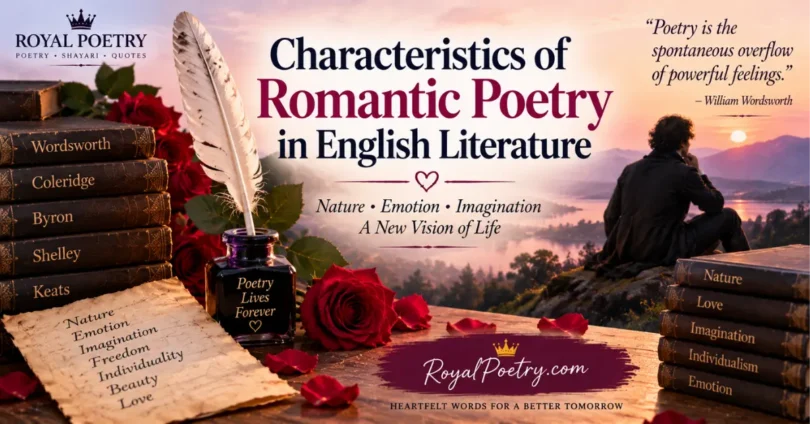
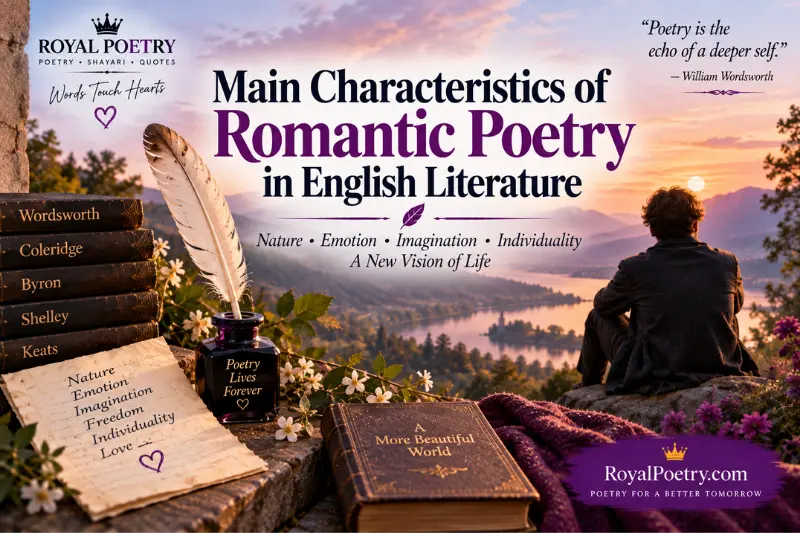
The main characteristics of Romantic poetry in English literature include a deep love of nature, powerful emotions, imagination, individual freedom, simple language, supernatural elements, childhood innocence, beauty, and an interest in ordinary people.
What Is Romantic Poetry?
Romantic poetry is the poetry of emotion, nature, imagination, and individual experience. It developed partly as a reaction against Neoclassical literature, which valued order, reason, balance, and strict rules.
Romantic poets believed that poetry should come from genuine human experience. Instead of writing mainly about kings, heroes, and upper-class society, they also wrote about farmers, children, villagers, wanderers, and other ordinary people.
The word “Romantic” does not mean that this poetry is only about romantic love. Romantic poetry can explore nature, loneliness, freedom, childhood, death, dreams, revolution, mystery, beauty, and spiritual experience.
Main Characteristics of Romantic Poetry in English Literature
1. Love and Celebration of Nature
Love of nature is one of the most important characteristics of Romantic poetry. Romantic poets did not use nature only as a beautiful background. They presented it as a living power that could guide, comfort, teach, and inspire human beings.
Mountains, rivers, forests, flowers, clouds, birds, and changing seasons often appear in Romantic poems. Nature may bring happiness to a sad person or help someone understand life more deeply.
William Wordsworth is especially famous for his treatment of nature. In I Wandered Lonely as a Cloud, the sight of dancing daffodils fills the speaker with joy. Even after the experience is over, its memory continues to comfort him.
For Romantic poets, nature could be:
- A source of beauty and pleasure
- A spiritual or moral teacher
- A reflection of human emotions
- A place of peace and healing
- A powerful force beyond human control
2. Importance of Emotion
Romantic poetry gives more importance to emotion than cold logic. Romantic poets explored joy, sadness, love, loneliness, fear, hope, wonder, and despair.
Their poems often show the speaker’s private feelings and personal experiences. Readers are invited to feel what the poet feels rather than simply understand an intellectual argument.
Wordsworth described poetry as the “spontaneous overflow of powerful feelings.” However, he also explained that poetic emotion is remembered and shaped in a calm state. Therefore, Romantic poetry is emotional but not necessarily careless.
This focus on emotion made poetry feel more personal, natural, and connected to real human life.
3. Power of Imagination
Imagination is another central feature of Romantic poetry. Romantic poets believed that imagination could reveal truths that ordinary reason could not discover.
Through imagination, poets transformed familiar objects and experiences into something beautiful, mysterious, or meaningful. A bird could become a symbol of freedom, a ruined building could awaken memories, and a wild landscape could produce feelings of wonder.
Samuel Taylor Coleridge’s Kubla Khan creates a dreamlike and almost magical world. His The Rime of the Ancient Mariner combines imagination, adventure, guilt, punishment, and supernatural mystery.
Imagination allowed Romantic poets to move beyond the visible world and explore dreams, memories, fears, and spiritual experiences.
4. Individualism and Personal Freedom
Romantic poetry celebrates the individual. It gives importance to personal identity, private experience, and freedom of thought.
Romantic poets often rejected social restrictions and traditional expectations. They believed individuals should be able to express their feelings and follow their own beliefs.
Many Romantic poems contain first-person speakers who describe their personal journeys, memories, struggles, and emotions. Lord Byron became famous for creating independent and rebellious characters. These characters often stand apart from society and refuse to follow ordinary rules.
Individualism in Romantic poetry includes:
- Freedom of expression
- Personal experience
- Independence from society
- Rebellion against authority
- Exploration of the inner self
5. Reaction Against Neoclassicism
Romantic poetry developed as a reaction against the order and strictness of Neoclassical literature.
Neoclassical writers valued reason, discipline, established literary forms, and classical models. Romantic poets preferred emotion, creativity, nature, freedom, and personal expression.
They did not completely reject poetic form. Many Romantic poets wrote sonnets, odes, ballads, and other structured poems. However, they believed that rules should not limit imagination or genuine emotion.
| Neoclassical Poetry | Romantic Poetry |
|---|---|
| Focuses on reason | Focuses on emotion |
| Values rules and order | Values freedom and creativity |
| Often discusses public life | Often explores personal experience |
| Uses controlled expression | Uses passionate expression |
| Follows classical models | Draws inspiration from nature and imagination |
6. Simple and Natural Language
Many Romantic poets wanted to make poetry understandable to ordinary readers. They moved away from overly artificial poetic language and used words closer to everyday speech.
Wordsworth strongly supported the use of common language. He believed that the lives and feelings of ordinary people were suitable subjects for serious poetry.
Simple language helped Romantic poets communicate deep emotions without unnecessary complexity. Their poems could be beautiful and meaningful while remaining connected to real life.
However, not every Romantic poet used the same style. Keats often used rich and sensuous descriptions, while Wordsworth generally preferred a more natural voice.
7. Interest in Ordinary People and Rural Life
Romantic poets gave attention to people who were often ignored in earlier literature. Their poems included shepherds, farmers, children, lonely travellers, village women, and poor workers.
They believed that ordinary lives could contain powerful emotions and important truths. Rural people were sometimes seen as being closer to nature and less affected by the artificial habits of city life.
Wordsworth’s The Solitary Reaper focuses on a young woman working and singing alone in a field. The event is simple, but her song creates a deep emotional experience for the speaker.
This characteristic made Romantic poetry more human, inclusive, and relatable.
8. Supernatural and Mysterious Elements
Ghosts, dreams, strange events, curses, visions, and mysterious places frequently appear in Romantic poetry. These supernatural elements allowed poets to explore the unknown side of life.
Coleridge is one of the best examples of this characteristic. In The Rime of the Ancient Mariner, the killing of an albatross leads to supernatural punishment and suffering. The poem creates an atmosphere of fear, mystery, and moral responsibility.
John Keats also used mystery and supernatural beauty in La Belle Dame sans Merci. The poem presents a knight who meets a strange and beautiful woman and later finds himself alone in a cold landscape.
Supernatural elements made Romantic poetry imaginative, dramatic, and emotionally powerful.
9. The Sublime
The sublime refers to an experience of overwhelming beauty, greatness, power, or fear. It often occurs when a person faces something much larger than themselves, such as a high mountain, stormy sea, dark forest, or violent storm.
A sublime experience can create wonder and fear at the same time. It reminds people that nature is beautiful but also uncontrollable.
Romantic poets used vast natural scenes to explore the relationship between the human mind and the universe. Percy Bysshe Shelley’s Mont Blanc presents the mountain as a symbol of nature’s mystery and enormous power.
The sublime is different from ordinary beauty. A flower may look beautiful, but a massive mountain covered in storms can feel sublime.
10. Childhood and Innocence
Romantic poets often presented childhood as a time of innocence, freedom, imagination, and spiritual understanding.
They believed children could experience the world with freshness and wonder. Adults often lose this natural vision because of social pressure, material concerns, and fixed habits.
William Blake explored innocence and experience in Songs of Innocence and of Experience. His poems show both the purity of childhood and the suffering caused by an unjust society.
Wordsworth also believed that childhood memories could shape adult identity. In his poetry, children sometimes understand truths that adults can no longer see clearly.
11. Interest in the Past
Many Romantic poets were attracted to history, old legends, folklore, ancient Greece, and the medieval period.
They often used the past as an escape from industrial society. Castles, knights, ancient objects, forgotten stories, and legendary figures gave their poetry a sense of mystery.
John Keats was deeply inspired by classical Greek art and culture. His Ode on a Grecian Urn examines beauty, time, art, and human life through an ancient object.
Interest in the past helped Romantic poets connect imagination with history and cultural memory.
12. Escapism
Romantic poetry sometimes offers an escape from painful reality. Poets turned toward nature, dreams, mythology, memory, or distant lands when the real world felt limiting.
The Industrial Revolution brought crowded cities, difficult working conditions, pollution, and rapid social change. Romantic writers often found emotional relief in natural or imagined worlds.
In Ode to a Nightingale, Keats wants to escape human suffering through beauty, poetry, and the nightingale’s song. However, he eventually returns to reality. This shows that escape may provide temporary comfort but cannot permanently remove human pain.
13. Revolutionary Spirit
Freedom and rebellion are important themes in Romantic poetry. The French Revolution influenced several Romantic writers, especially during its early period.
Poets such as Percy Bysshe Shelley and Lord Byron challenged political oppression, social injustice, and traditional authority. Shelley believed poetry could inspire people and contribute to social change.
His Ode to the West Wind presents the wind as both a destructive and creative power. It removes what is old and prepares the world for renewal. The poem can therefore be understood as a desire for personal, social, and political change.
14. Beauty and Sensuousness
Romantic poetry often appeals to the senses. Poets describe what people can see, hear, smell, taste, and touch.
John Keats is particularly known for sensuous language. His poems contain rich descriptions of flowers, music, food, colours, seasons, and physical beauty.
Sensuous imagery allows readers to experience a poetic scene more clearly. It also helps poets connect physical beauty with deeper questions about truth, mortality, imagination, and art.
15. Symbolism
Romantic poets frequently use natural objects as symbols. A bird may represent freedom, a storm may represent revolution, and a changing season may represent death or renewal.
For example, the west wind in Shelley’s Ode to the West Wind is more than a natural wind. It symbolizes change, destruction, creative energy, and the hope of a new beginning.
Symbols give Romantic poems multiple layers of meaning. A reader can enjoy the literal scene while also thinking about its emotional, philosophical, or political significance.
16. Melancholy and Awareness of Death
Sadness, loss, loneliness, passing time, and death are common subjects in Romantic poetry. Romantic poets understood that beauty does not last forever, and this awareness often makes beauty feel more valuable.
Keats frequently connects beauty with mortality. In Ode to a Nightingale, the seemingly timeless song of the bird is contrasted with human suffering and death.
Romantic melancholy is not simply hopeless sadness. It can lead to reflection, emotional depth, and a stronger appreciation of life.
Major Romantic Poets and Their Famous Works
William Wordsworth
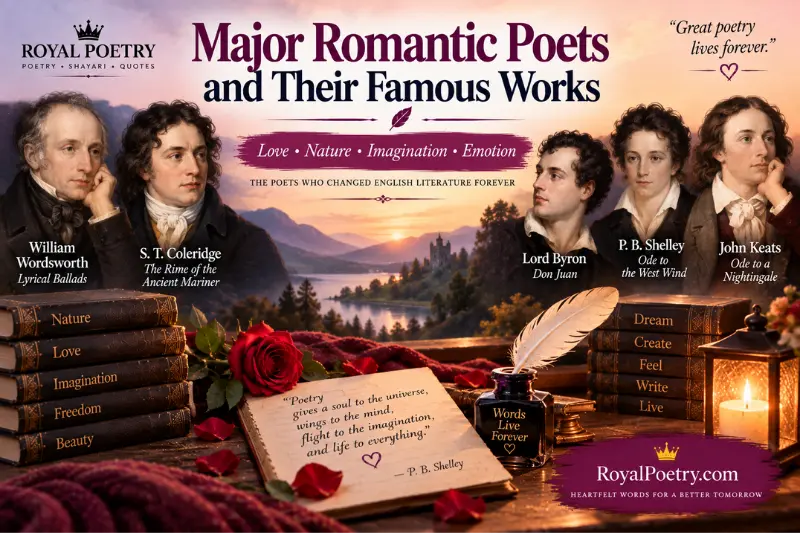
Wordsworth is known for nature, childhood, memory, rural life, and simple language. His famous works include I Wandered Lonely as a Cloud, Tintern Abbey, and The Prelude.
Samuel Taylor Coleridge
Coleridge is famous for imagination and supernatural themes. His major poems include The Rime of the Ancient Mariner and Kubla Khan.
William Blake
Blake wrote about innocence, experience, spirituality, freedom, and social injustice. His best-known collection is Songs of Innocence and of Experience.
Lord Byron
Byron’s poetry celebrates freedom, rebellion, strong personality, and the outsider. His works include Childe Harold’s Pilgrimage and Don Juan.
Percy Bysshe Shelley
Shelley wrote about political freedom, imagination, nature, change, and idealism. His famous poems include Ode to the West Wind and To a Skylark.
John Keats
Keats is known for beauty, sensuous imagery, imagination, art, and mortality. His major works include Ode to a Nightingale, Ode on a Grecian Urn, and To Autumn.
First and Second Generations of Romantic Poets
English Romantic poets are commonly divided into two generations.
The first generation includes William Wordsworth, Samuel Taylor Coleridge, and William Blake. They helped establish the movement through their attention to nature, ordinary life, imagination, and spiritual experience.
The second generation includes Lord Byron, Percy Bysshe Shelley, and John Keats. Their work often contains rebellion, beauty, political freedom, idealism, sensuousness, and awareness of death.
Despite their differences, both generations valued imagination, emotion, and individual expression.
Why Is Romantic Poetry Important?
Romantic poetry changed the direction of English literature. It made personal feelings, common people, childhood, imagination, and nature suitable subjects for serious poetry.
It also gave poets greater creative freedom. The movement influenced later poetry, fiction, music, painting, and modern ideas about individual identity.
Romantic poetry remains popular because its central subjects are still relevant. People continue to search for freedom, beauty, emotional connection, meaning, and peace in nature.
Short Answer: Characteristics of Romantic Poetry
Romantic poetry is characterized by love of nature, strong emotions, imagination, individualism, simple language, supernatural themes, childhood innocence, interest in ordinary life, revolutionary ideas, beauty, symbolism, and the sublime. It developed as a reaction against the strict rules and rational approach of Neoclassical literature.
Frequently Asked Questions
What are the five main characteristics of Romantic poetry?
The five main characteristics are love of nature, strong emotion, imagination, individualism, and freedom from strict literary rules.
Is Romantic poetry only about love?
No. Romantic poetry is not limited to romantic relationships. It also discusses nature, freedom, childhood, beauty, death, politics, mystery, spirituality, and imagination.
Who is called the father of English Romantic poetry?
William Wordsworth is often described as a central founder or leading figure of English Romantic poetry. His work with Samuel Taylor Coleridge, especially Lyrical Ballads, played an important role in developing the movement.
When did Romantic poetry begin?
English Romantic poetry is commonly associated with the late eighteenth and early nineteenth centuries. The publication of Lyrical Ballads in 1798 is widely treated as an important landmark.
Why did Romantic poets focus on nature?
Romantic poets viewed nature as a source of beauty, wisdom, spiritual power, freedom, and emotional healing. They also used nature as an alternative to crowded cities and industrial society.
How is Romantic poetry different from Neoclassical poetry?
Neoclassical poetry mainly values reason, order, tradition, and controlled expression. Romantic poetry gives more importance to emotion, imagination, individuality, nature, and creative freedom.
What language did Romantic poets use?
Many Romantic poets used simple and natural language connected to everyday speech. However, some poets, particularly John Keats, also used rich and highly descriptive language.
Which poem is a good example of Romantic poetry?
Wordsworth’s I Wandered Lonely as a Cloud is a clear example because it combines nature, memory, imagination, personal emotion, and simple language.
Final Thoughts
The characteristics of Romantic poetry in English literature show a major movement away from strict rules and pure reason toward nature, emotion, imagination, and individual freedom.
Romantic poets saw value in ordinary people, childhood memories, personal feelings, mysterious experiences, and the beauty and power of the natural world. Writers such as Wordsworth, Coleridge, Blake, Byron, Shelley, and Keats gave English poetry a more personal, expressive, and imaginative voice.
Their poetry continues to influence readers because it speaks about experiences that remain universal: love, loneliness, hope, beauty, freedom, loss, and the human desire to understand both nature and the inner self.